
“I’m broken.”
“There’s something wrong with me.”
“I’m just not able to get aroused anymore.”
And often on the other side of the equation:
“I just want to be wanted.”
“I don’t feel loved.”
“I can’t get it right.”
“I’ve given up.”
Hormone imbalances, sexual skills, insight into childhood trauma, communication skills, and strategies. These are often the go-tos for addressing sexual challenges. I know firsthand how frustrating it can feel not to be able to muster sexual desire in a relationship, and how this can become a hot-button issue.
Unlike many of the couples Angus and I work with, I wasn’t going through these challenges during perimenopause or menopause, or even when struggling to balance parenting young children with work. The first time I experienced this challenge was in the prime of my hormonal years, pre-children. I tried the mindfulness classes, tantra workshops, and couples therapy. I owned my projections, screamed into pillows, smashed my bataka, immersed myself in float chambers, and still felt shut down when it came to sex and desire. My body was not responding the way I thought it should.
When I talked to my gynaecologist about it, he dismissed it as normal, just what happens after marriage. Somehow, I knew this couldn’t be true.
Then, in my late forties, after many more years of marriage and in the thick of parenting a tween and a teen, I suddenly found myself naturally rediscovering my sexual appetite and desire.
What happened had nothing to do with sex. It was a felt experience of the peace, well-being, and reality of my true nature that allowed me to experience a freedom to be myself I hadn’t felt before. My nervous system recalibrated, and I was able to be more present, less caught up in my mind. This impacted every area of my life, so it makes sense that sex would be included.
When I asked one of my mentors how they would approach this with someone struggling the way I did, they said they wouldn’t talk about it. There would be too much conditioned thinking to cut through, so it is best to look in a different direction and trust that better sex would probably be a natural outcome.
But my Scorpio nature can’t be held at bay forever, and I’m sure I’m not the only person who has experienced this. It feels worth exploring directly.
You Can’t Effort Your Way to Desire
Working with couples, there are few subjects that carry the weight and tension of physical intimacy. Sex can become a lightning rod. One partner may feel their needs are consistently unmet, while the other feels a chronic, often unseen pressure. Over time, this often leads to a quiet withdrawal and a general decrease in intimacy that extends well beyond the bedroom.
This is often where couples are when they arrive at an intensive with Angus and me.
The Recognition Beneath the Problem
Here is what I have come to see for myself and others: challenges with arousal and the associated sexual frustration couples experience are not ultimately about sex. The arousal challenge is a guide. It is the wisdom of our body revealing that we are caught up in thought, and the body is not feeling safe.
When we are identified with thought, caught in worry about performance, judgment about our bodies, comparison, self-consciousness, or perhaps just intrusive thoughts about the shopping or the incomplete to-do list, we are not able to inhabit our bodies. And there is an irony here. When we have a chronically busy mind, it is often only when we slow down to enjoy sexual intimacy that we suddenly become aware of just how busy it is. All the thoughts get loud.
Angus and I used to joke that I had sexual ADD. We would be all cozy and ready to embark on sexual adventures, and I couldn’t focus. All of my worries would come rushing into my mind. The least sexy thoughts possible would be thundering through my consciousness, luring my attention away. I would need to do a mind dump before we moved forward. I’m not suggesting this as a technique for anyone else. It was probably the least sexy foreplay ever, and thank goodness it didn’t kill Angus’s sexual spark. But that is what I did to empty my mind so that I could be present, and my body could feel safe to experience what it is capable of experiencing.
Why Trying Makes It Worse
In our culture, “sexy” is often divorced from the actual intimacy of meeting another person. We are taught to focus on performance and outward cues rather than internal presence. Even when both partners wish to connect, they can feel betrayed by their own biology. Desire seems elusive, or the body does not respond with arousal. This is intensely frustrating because arousal exists completely outside of our willpower. It is not something we can force or engineer. In fact, the more we try to create arousal through sheer effort, the more stubbornly it seems to hide.
Here is the central paradox. The more we think about how to have good sex, the more pressure we feel and the less likely it is to be available. Intimacy cannot be engineered through effort or achieved through intellectual understanding. It cannot be fixed simply with better techniques or more communication strategies.
Why? Because the very effort to fix it keeps us in the thinking mind. And real sex, the meeting of two conscious beings, can only happen when we step out of our heads and into presence.
Presence is consciousness itself. It is the awareness that exists prior to and independent of thought. In presence, we are not analyzing or performing. We are directly here, inhabiting our bodies, attuned to another person, responding to what is actually alive between us rather than what we think should happen.
The Body’s Honest Feedback
We are used to treating a lack of arousal as a physical malfunction to be fixed. But what if it is not a malfunction at all? What if it is the body’s honest communication about our state of mind?
The body responds to presence. When we are truly present, not thinking about ourselves, not monitoring our performance, not caught in fear, the body naturally relaxes and opens. When we are absent, up in our thinking mind, identified with our stories, the body protects itself. It is not broken. It is wise.
When arousal is challenging, it is often useful to look past the physical mechanics entirely and recognize what is actually happening. We are mind-identified. We are caught up in a story about ourselves, our partner, life, or sex itself, and the body does not feel safe. The busy mind is a coping mechanism we retreat to when presence feels like too much. The vulnerability of not just being naked with another human but being emotionally exposed is often more than we believe our nervous system can bear, and so the ego escapes into the mind. This is good for escape, but it is not good for sex.
Presence Begins Outside the Bedroom
For great sex, technical skill alone isn’t enough. It requires presence, which means being able to meet yourself and all the feelings that arise. It means welcoming whatever shows up, whether shame, grief, or joy. Being sexually intimate, rather than just going through disconnected motions, means showing up fully and connecting deeply. This is often not how we live our day-to-day lives, let alone how we engage in what can feel like a tricky activity. No wonder arousal can feel elusive.
This is why cultivating presence with yourself and your partner outside of sexual activity matters so much. Are you safe enough outside of the bedroom to open your heart and share yourself vulnerably? Is there truly a feeling of safety to be yourself, within yourself and with another?
The importance of emotional safety for arousal and desire cannot be overstated. The body responds to safety and opens to pleasure. This is especially true when arousal isn’t spontaneous and needs space to emerge, as is common in long-term relationships, and especially for women.
The Spiritual Trap of Chasing Good Feelings
Being open to all of our feelings can feel confusing for some on a spiritual path. Having experienced the deep peace and blissful feelings of our true nature, where the infinite expanse of who we are can feel so intoxicating, there can be an understandable attachment to positive feelings. But even though our true nature doesn’t change, our experience is constantly shifting.
I used to live in the misunderstanding that I could pursue a path of self-improvement and be rewarded with more and more positive feelings and spiritual highs, until I realized the futility and exhaustion of this. Running away from certain feelings is impractical because it is impossible. It only leads to more suffering.
The freedom to realize the safety of being with all feelings is where true liberation resides.
And this isn’t always easy. I still find myself contracting around certain feelings and have to remind myself to open to what is rather than resist it. This can feel like the least sexy activity, and it certainly isn’t only for times of sex, but it is equally important for physical intimacy.
Rather than being focused on arousal, can we meet what is arising with an open heart and be transparent with our partner? This is what leads to the real safety for arousal to arise.
No Desire Is Also Welcome
Lack of arousal is not a problem. It is simply feedback about what the body needs. Having room for the experience of no desire allows us to feel what is present and understand what wants to be met. When I think back to my times of struggle with arousal, I was not feeling safe within myself, and I was experiencing painful emotions that felt completely unwelcome to me, and perhaps to my partner, during the experience.
Ironically, letting go of attachment to a certain experience during physical intimacy is what creates the container for deeper pleasure.
For me, this required a shift in consciousness that allowed me to live with a deeper feeling of safety within myself, and this translated into physical intimacy.
So I guess my mentor was right. Deeper pleasure and fulfilling sexual intimacy can be a by-product of a deeper experience of our true nature, the kind that creates lasting change. A freer mind can lead to better sex.
I don’t want to dismiss the role hormones, health, and skill can play. But these are discussed much more widely than the value of a quiet mind and an open heart for creating the quality of intimacy that allows pleasure, desire, and arousal to flourish. The intimacy we long for is not something we create. It is what is revealed when we feel safe enough to be fully here.
It turns out the bedroom was never the problem.
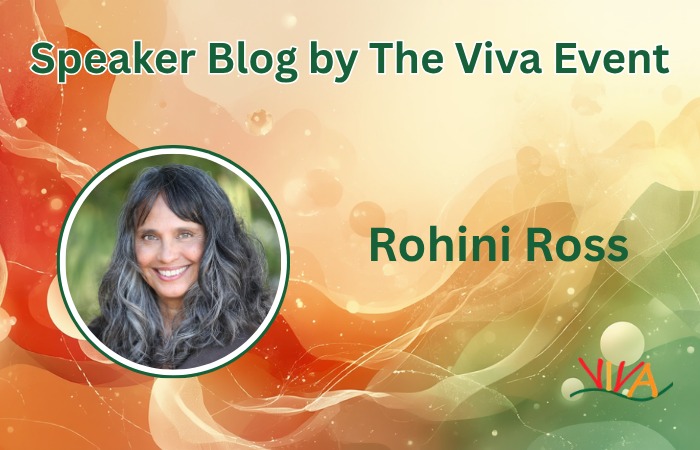
To connect with Rohini Ross and find out more about the work she does, please visit the link: www.rohiniross.com
If you would like to spend time with speakers like this in person and hear them share their wisdom and experience in a beautiful setting in Albir, Spain in November each year, you can find tickets here www.thevivaevent.com/registration